Thursday, September 23, 2010

'X' Marks the Spot - Part 1


Cross-stitch is a skill I learned as a child.  It’s a pleasurable distraction that is useful as well as beautiful.  It is a form of embroidery in which X-shaped stitches are used to form a picture.
 When I was learning I did a form of cross-stitch called stamped cross stitch.  This is where the pattern is printed on the fabric and the stitcher marks the ‘X’ over the outline.  It is easy and doesn’t require a lot of thought.

Now that I’m all grown up and enjoy more of a challenge, I prefer counted cross-stitch.  With this form, the stitches are counted across a blank canvass using a pattern and color chart to make the desired image. 

I generally buy a kit with the fabric and floss and pattern all together in one package.  Although, I have made my own patterns with success. 

Cross-stitch is usually carried out on an even weave fabric called aida cloth; which allows for stitches are uniform size and appearance. Cotton floss is the most common embroidery thread made up of six strands that are only loosely twisted together and easily separable. Sometimes other specialty threads are used for accents and embellishments.

To start, find the center of the graph. Most patterns show this with arrows or a bold line. Next, find the center of your fabric. An easy way to do this is to fold the fabric in half vertically and "pinch" with your finger to make a small crease. Open the fabric, fold in half horizontally and make another "pinch". Open the fabric up. The two creases will mark the center of the fabric. It is easiest to start at the center of the pattern.

To begin stitching, bring the threaded needle up from the back of the fabric leaving about a 1" tail of thread behind the fabric.  There is no need to knot it.  Stitch the next 5 or 6 stitches over the tail. Clip off extra thread. To end off, weave your needle back through the last 5 or 6 stitches and clip the thread short so as not to leave a loose tail.

There are two methods methods for stitching.  I’ve used them both and have no real preference for either.  The first method is to work a row of half stitches (////), then work back (\\\\) to complete the X's. Use this method for most stitching. The second method is to complete each X as you go. Use this method for vertical rows of stitches.
It is important that all the X's are crossed in the same direction. That is, the top thread of the X should always slant in the same direction (either \ or /). It does not matter which way they slant, but if they are mixed the finished piece will look uneven.

Do not pull the thread tight.  Relax and enjoy making the pattern.  Your stitches should lay flat on your fabric and not distort the holes or the fabric.
Sometimes a color will have only a few stitches and then "jump" to another area. Most of the time you should end off and start again, other times you can carry the thread along the back. Just jumping from area to area is easier than starting and stopping, but sometimes the thread will show through.

When your stitching is complete, wash in cool water using a mild liquid detergent. Rinse well. Do not wring, but roll in a clean towel to absorb most of the water. While still damp, place face down on a terry towel. Place another cloth on top of the needlework and press lightly with a warm iron. Let dry. Then frame or finish as desired. 

Wednesday, September 22, 2010

Who ya callin' jerky, jerky - Part 2


The process of drying meats goes back for centuries. Cured preserved meat, also called jerky was a food of the American Indians as a means of survival. It’s lean, loaded with protein . . . a very good source of energy.  You can use almost any kind of meat to make jerky - beef, turkey, chicken, hare, pork, deer, bison, buffalo and even fish can be made into jerky – but it must be lean or it will go rancid in long term storage.

Previously, I showed you how to make jerky from strips of lean meat.  Now I’m going to show you how to make jerky from ground meat.

Making jerky from ground meat means no marinating, no slicing, no fuss, no muss.  All it takes is very lean ground meat and time.

To make it easier I have a Nesco Beef Jerky Factory.  It’s basically a device to extrude the ground meat into strips or sticks.
You can get pre-packaged flavorings for your jerky or you can make your own.

The following recipe is a basic flavor jerky, which it can be used as a guide to experiment with your own seasoning.

Things You'll Need:
  • 5 Pounds  Ground Lean Meat  (At Least 95% Lean)
  • 2 Tablespoons Salt
  • 1 Teaspoon Curing Salt
  • 1 Tablespoon Garlic Powder
  • 1 Tablespoon Onion Powder
  • 2 Teaspoons Cayenne Pepper
  • 2 Teaspoons Black Pepper, Or 1/4 Teaspoons Freshly Ground
  • 2 Teaspoons Curry Powder

Mix and knead well.

If you are making the jerky by hand, form meatballs to the size of a golf ball until you finished using up all the ground meat.  Flatten the balls between two pieces of waxed paper with a rolling pin.  Cut them into strips or squares.


I use a Nesco dehydrator.  But if you’re using an oven, place the strips on a cookie sheet.  Set oven at lowest temperature setting. Leave the oven door open slightly to allow moisture/vapor to escape. "Dry-heat" the jerky until desired dryness is reached, and ready to eat; (about 4 to 12 hours, depending on the meat moisture).

Store the jerky in an air-tight container and place it in the fridge up to one week. Jerky is good up to 1 year if stored in the freezer.

Experiment with different flavors:

Substitute for the seasoning ingredients in the "Things You'll Need" list, except for the 5 pound ground meat.

  • Teriyaki jerky: 1 cup Worcestershire sauce, 2 cups soy sauce, 1 teaspoon black pepper, 2 teaspoon garlic powder, 2 teaspoons onion powder.
  • Pepper jerky: 1 teaspoon curing salt, 2 tablespoons table salt, 2 tablespoons white pepper, 2 tablespoons freshly grind black pepper, 2 teaspoons ground coriander, 1/2 cup non-fat dry milk powder, 2 teaspoons liquid hickory smoke, 2 cups cold water.
  • Hot and spicy jerky: 1 teaspoon curing salt, 2 tablespoons salt, 2 teaspoon crushed red chili peppers, 2 teaspoons cayenne pepper, 2 teaspoons chili powder, 2 teaspoons ground coriander, 2 teaspoons liquid hickory smoke, 2 cups cold water.
  • Honey and brown sugar jerky: 1 teaspoon curing salt, 2 tablespoons salt, 2 teaspoons white pepper, 3/4 cup honey, 2 teaspoons ground coriander, 2 tablespoons ground mustard seed

Tuesday, September 21, 2010

The Apple of My Eye


Of all the delicates which Britons try
To please the palate of delight the eye,
Of all the sev'ral kings of sumptuous far,
There is none that can with apple pie compare.


My son went apple picking and brought me a bag full of apples.  We made applesauce with some but he wanted to make his very own apple pie . . . from scratch.  All I did was slice the apples and offer advise, he did the rest.  It came out good.  It wasn’t the prettiest apple pie you ever saw but was yummy.

Here’s how he did it . . .

Since the pie crust dough has to be refrigerated for an hour, we started there.

Making dough for the crust:

You will need:

  • 2 1/2 Cups Flour (For A Two Crust Pie)
  • 1 Stick Unsalted Butter Cut into Small Cubes or ½ Cup Vegetable Shortening/Lard
  • 1/4 Cup Ice Water
  • 1 Tablespoon Salt
  • 1 Tablespoon Sugar

We used the Kitchen Aid mixer with the mixing attachment to make the dough. 

In the mixing bowl, mix together the flour, salt, and about a tablespoon of white sugar.  Add the fat of your choice - shortening makes for a flakier crust but we also like the buttery taste so we used half butter and half shortening.  Mix until the mixture takes on a coarse, lumpy consistency. Its fine if a few small chunks of butter remain.  

Sprinkle in cold water until the dough is no longer crumbly and can be lifted and handled without splitting apart.  Separate into two equal pieces, wrap in plastic and put in the refrigerator.

When you’re ready to make the crust, place half of the dough between two pieces of wax paper (to prevent sticking and to make for easier cleanup).
  Flatten into a circule using a rolling pin until it is a bit larger than your pie pan.  It shouldn’t be more than a half an inch thick.  
Remove the top piece of wax paper.  Place the pie pan upside down on the crust, make sure it’s centered.  I slip a cutting board under the bottom piece of wax paper for rigidity then turn the crust and the pie plate over and peel the wax paper off. 

Press the dough into the pan. 

Roll out the second half of dough in the same manner as the first and set aside.


To make the pie filling you will need:
  • 1/4 Cup White
  • 1/4 Cup Brown Sugar
  • 1 Teaspoon Cinnamon
  • 1 Teaspoon Nutmeg
  • 6-8 Apples (we used McIntosh, but I prefer Granny Smiths)
  • 2 Tablespoons Lemon Juice (if desired)
  • 1 Egg
  • Salt
Peel, core and slice the apples. Mix together the white and brown sugar, cinnamon, lemon juice and nutmeg if you are using them, and a pinch of salt.
Add the apples and try to fully cover each piece with the sugar mixture.  (If it was *MY* pie I would mix some rum into the mixture)
 Pour the apples into the prepared pie pan. The apples will likely stack higher than the top edge of the pan, but they will shrink during baking.
Top with the second crust.  Put a few slashes in the center of the crust to vent the steam.   Press the edges of the bottom crust and top crust together to form a firm seal.  Mix the egg with a few teaspoons of water. Brush this egg wash over the dough, especially the edges. I also place strips of tin foil on the edges to prevent them from over cooking then remove during the last 15 minutes of backing.
Put the pie on the top or middle rack of a pre-heated 350 degrees Fahrenheit oven for about an hour.

Let cool on a rack for at least 10 minutes before diving in.

Serve with vanilla ice cream and or whipped cream.  Or my absolute favorite, serve the warmed pie with a slice of super sharp cheddar cheese!


 Pie facts and what-not


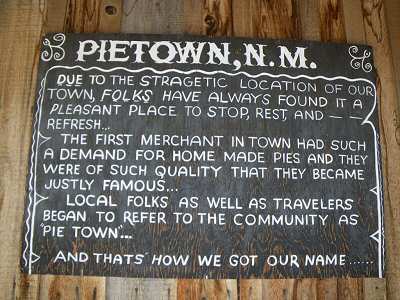
The unincorporated community of Pie Town, New Mexico is named in honor of the apple pie.


Originally pies were simply a means of storing and preserving food.  Pies were filled with foodstuffs and then folded over – similar to what a Calzone would look like.  The crust was very hare and not meant to be eaten.  


Shoo-fly pie is a wet-bottom molasses pie that was originally used to sit on windowsills to attract flies away from the kitchen.


During the Dark Ages in Old England pies were originally called “coffins” or “coffyns”.  Morticians eventually borrowed the word of “coffyn,” for somewhat obvious and very morbid reasons.


Pie

Coffin

Same Thing


A pie resembles a box to bury someone in.  A pie is often made with a dead animal inside.  So, there you have it.


From the cookbook (1390) The Forme of Cury a recipe “For To Make Tartys in Applis”

Tak gode Applys and gode Spryeis and Figys and reyfons and Perys and wan they are wel ybrayed co-lourd wyth Safron wel and do yt in a cofyn and do yt forth to bake well.


And from the cookbook (1600) Proper newe Booke of Cokerye (declarynge what maner of meates be beste in season, for al times in the yere, and how they ought to be dressed, and  serued at the table, bothe for fleshe dayes, and fyshe dayes)

To make pyes of grene apples - Take your apples and pare them cleane and core them as ye wyll a Quince, then make youre coffyn after this maner, take a lyttle fayre water and half a dyche of butter and a little Saffron, and sette all this upon a chafyngdyshe tyll it be hoate then temper your flower with this sayd licuor, and the whyte of two egges and also make youre coffyn and ceason your apples with Sinemone,Gynger and Suger ynoughe. Then putte them into your coffin and laye halfe a dyshe of butter above them and so close your coffin, and so bake them.

Monday, September 20, 2010

Afternoon Delight - A Lunchtime Quicky #3


A quickies make me happy . . . no, not THAT . . .


NOMS!  That's what I'm talking about.


If you’re like me, you wake up in the morning barely able to throw together a cup of coffee.   On top of that you have to rouse your brain cells enough to try to come up with something to take to work for lunch.  Something better than a can of beefaroni, a bologna sandwich or ramen noodles.

It really doesn’t take much to put together a good healthy lunch.  Its even better if you can make something the night before that you can grab on your way out the door in the morning.
This is that something . . . and it is a perfect pairing of flavors that will have you looking at the clock, waiting for it to tic to noon.

For a refreshing, light lunch or snack that is guilt free and perfect in its simplicity there are few things that compare with the combination of a luscious ripe tomato with fresh mozzarella. 
Add a splash of good balsamic vinegar and extra virgin olive oil.  A sprinkling of fresh ground pepper, sea salt and a leaf of fresh basil.  That’s all it take for a refined dish that couldn’t be easier to prepare. 

For a little more substance, layer the ingredients on a slice of crunchy garlic toast.

For a little more pizzazz, add a slice of avocado or roasted garlic.

Nom-dilly-icious!


Sunday, September 19, 2010

Comfort and Joy in a Pot


Comfort food n.
Food that is simply prepared and associated with a sense of home or contentment.

It makes you feel good when you’re down.  It reminds you of childhood and family.  It soothes and warms your soul.  It makes you feel good.

Pot Roast is one of those things for me.  It’s a meal that brings to mind brisk fall air, colorful leaves and home.  It’s a cozy up on the couch with a warm blanket and good book kind of meal.  It’s quick to prepare and doesn’t require a lot of effort.  Let it cook in the crock pot all day and the smells of warmth and comfort permeate the house. 
 This recipe is THE best pot roast . . . EVER!

I’ve been using this recipe of years.  It has never failed and is always superty duperty NOM-dilly-icious!
  
What you need:


  • 1 Beef Roast, Any Kind
  • 6 Medium Potatoes, Quartered
  • 4 Medium Carrots, Cut Into 1-Inch Pieces
  • 4 Medium Parsnips, Cut Into 1-Inch Pieces
  • 1 (1 1/4 Ounce) Packages Brown Gravy Mix, Dry
  • 1 (1 1/4 Ounce) Packages Dried Italian Salad Dressing Mix
  • 1 (1 1/4 Ounce) Packages Ranch Dressing Mix, Dry
  • 3/4 Cup Water
 
Directions
Place beef roast in crock pot.  Surround the roast with the vegetables. 
Mix the dried mixes together in a bowl and sprinkle over the roast.
Pour the water around the roast.

Cook on low for 7-9 hours.

That’s it!  OMG so good!


    Saturday, September 18, 2010

    Make room in 'em for aluminum

    Remember when you could only open a beer can with a can opener?  No, me neither, but there was a time that you had to have a church key to get your beer can open.  Can you imagine??  What if you lost your key or forgot your key or got too drunk to use the key.  What a nightmare . . .

    Necessity is the mother of invention . . . the man who invented pull tabs had indeed forgotten his church key.  He spent the day opening his beer cans on the bumper of his car.  There just had to be a better way and he figured it out.

    The first zip tabs were invented around 1962.  I don’t remember THOSE either.  The pulled off leaving sharp edges and silly drunken people were getting cut up from them, fingers, lips, noses . . . bloody beer isn’t the best. But the alcohol will kill any potential infection and dull the pain.  Of course it also thins the blood and makes you bleed more . . .

    The ring style tabs were introduced in 1965. Nope, I don’t remember those either . . . well, okay . . . maybe just a little. Of course, the brainiacs of the population would put the tabs inside the cans, swallow them or choke on them.  Or, they would throw them on the ground for others to get cut up on.

    The pull tabs that we all know and love today were introduced in 1975.  They’re safe because they take a bit of work to get off the can.   And they make awesome jewelry and chainmail!

    However, if you’re not so motivated to make stuff out of them, save them for the Shriners or Ronald McDonald House.  There is more concentrated metal in the tab than in the rest of the can and they recycle them for $$$.  You can still get your deposit back on the can and make a donation to a worthwhile charity.  The tabs add up fast; especially if you drink as much beer . . . or soda   . . . as we do. 

    You can also save the tabs off any other pull tab can  . . . cat food, soup, vegetables, whatever.

    But if you want to make something cool and stylish here’s how to make a Pop Tab Bracelet
     
    The instructions I am using are courtesy of DIY


    What you’ll need

    Scissors
    Cord
    20 To 25 Soda/Beer Can Tabs


    • You can use any kind of cord or string or ribbon.  Elastic cord will give more stretch-ability.  I use crochet thread

    • Note: You need to work with an even number of rings, and make sure the center ring in the pop top is missing. 

    • For every side there is a smooth top and a rough side. You want to make sure the rough side is sandwiched inside because you want the smooth side next to your skin.

    • Take two lengths of cord and clip together the far left ends with one binder clip, allowing some space between them.
    • Take the first two tabs and overlap them (rough sides together). String top cord into top hole (front to back), then pull cord through (back to front) via the overlapped hole. Repeat with bottom hole and bottom length of cord. Drag tabs to the left such that they rest about 1/2" from their bound ends.

    • Add third tab by setting it next to the first tab (rough side in), then pull top cord into the bottom overlapped hole of the second and third tab (front to back). Take bottom cord and place in top overlapped holes. The cords will now be criss-crossed. Ensure tabs are snuggled next to each other.
    • Flip over. Add a fourth tab by setting it next to the second tab (rough side inward), and now pull top cord into top overlapping holes of the third and fourth tabs (front to back). Do the same with the bottom cord strand into the bottom overlapping holes. The cords on this side will be parallel.
    • Flip over again. Add a fifth tab by setting it next to the third tab (rough side inward), and pull the top cord into bottom overlapped hole of fourth and fifth hole (front to back). Pull bottom cord through the top overlapped hole.
    • Continue in this manner, adding tabs in such a way that one side of the bracelet will have criss-crossed cords, and then other will have cord parallel, until you have added 20 tabs total. (Quickly wrap bracelet around your wrist to access if 20 is enough. If not, add more tabs accordingly, just make sure you have an even number of tabs in the end.)

    • Bend the bracelet by connecting the ends so you can see how they fit together. The far left and right tabs will overlap. Hold in place.
    • Remove binder clip from one side. Pull top and bottom cord cords into overlapped holes to close off bracelet. Tie matching cord ends together and cut off excess. Turn bracelet inside out to hide knots.