Showing posts with label Fibre Arts. Show all posts

Saturday, March 17, 2012

The web of our life is of a mingled yarn


A simple crocheted washcloth is a basic project this is gratifying because it is quick, inexpensive and something you can use everyday.

This is a great project for beginners.  If you know the fundamentals of crocheting then you can make a pile of these in no time.  


It’s also an easy distraction for more experienced crocheters . . . like myself.  I work on these uncomplicated washcloths while I’m watching television or riding along in the car.

As you become more adept at making these you can easily develop your own patterns with more complex stitches while using this pattern as a template.

Basic Single Crochet Dishcloth

Materials
2 ounces worsted weight cotton yarn, any color
Size G crochet hook

Finished size 10 1/2 inches x 9 1/2 inches

It doesn’t matter if yours ends up smaller or larger.  It’s just a dishcloth. Any size is fine.

To start:
Leave about a six inch length of yarn before the first loop of your starting chain. Leave this length hanging while you are crocheting the dishcloth. You will weave this length in when the dishcloth is finished. (This is a good way to secure the end so it won't unravel.)

This link will take you to step-by-step photos for how to make a starting chain.

Starting chain: chain 36.
Note: At the end of each row, you will chain 1, then turn the work around to start the next row.
Row 1: Single crochet in the second chain from the hook, single crochet in each chain across. (35 single crochet)
Row 2: Single crochet in each single crochet across. (35 single crochet)
Rows 3 - 38: Repeat row 2.
End off, leaving a length of about 6 inches to weave in. Weave in the ends, using a large-eye yarn needle.

Saturday, April 16, 2011

When caterpillar poop fell like rain


The several summers in the mid-80s the Appalachians were overrun with Gypsy Moths.   The wreaked havoc by defoliating miles and miles of trees . . . leaving a trail of devastated forests in their wake.   You couldn’t walk anywhere without smooshing them underfoot; green goop bursting out of one end or the other. Strings and strands of wiggly critters dangling from translucent strands everywhere, hanging like wretched decorations from branches.   You could literally hear their poop falling through the trees like rain.  They were everywhere and they were gross.


Nary a day would pass that planes couldn’t be seen flying overhead spraying insecticide to try to stop the munching army of leaf eaters.


I remember walking along the road with a can of Raid and a lighter flaming up nests anywhere I spotted them; taking grim satisfaction in destroying the horrid creatures.  Thinking back on it that was a really stupid thing to do.  You see, I was a young teeny-bopper at the time and I’m lucky I didn't cause a major fire in the process.  


I remember marching in a Memorial Day parade and the caterpillars would literally be falling on our heads and shoulders and were covering the road as we moved along the parade route.  That experience ruined the enjoyment of parades for me for years.  


Gypsy moth caterpillars were introduced into Massachusetts in 1869 for a silkworm-breeding program. A number of the insects escaped, and by the early 1900’s were responsible for major defoliation of forests in northeastern US. Gypsy moths arrived in western Pennsylvania in the late 1980’s and have continued their westward movement as far as Minnesota. The common name “gypsy moth” comes from the way they move from area to area: on the wind. Their progress across the country has been slowed by our prevailing winds from the west; had they been introduced on the west coast, they would have covered the United States long ago.


Gypsy moth caterpillars have five double rows of blue spots followed by six double rows of red spots on its back and very hairy.   In its native European range, gypsy moths has natural enemies such as parasites and diseases keep it in balance with its environment.  In the United States, they don’t have natural enemies and they move so fast through areas that any potential predators they may have don’t have a chance to react to their presence.   When Gypsy moths begin their mid-June rampage, all leaves on an oak tree can be eaten within a week! 


___________________


I have lots of yarn that I have no idea what to do with.  Much of is donated yarn from other stashes that I snatched up in a moment of fiber induced hysteria.  Most of it is stuff I wouldn’t use for finer projects; like socks, sweaters and whatnot.


A practical and easy way to utilize this yarn is to make I-cord pot holders.  You can use all one color or whatever color combination suits your fancy. 

Like I said, knitting I-cord is easy peasy . . . knit knit knit . . .easy enough for a beginner.

This is the technique I learned.  It's fun and goes fast.


Using short double-pointed (DP) needles, cast on a small number of stitches, 3, 4, 5 or 6 stitches.


Knit, don't turn.


Slip the stitches back to the beginning of the needle and knit the row again.


Continue in this manner until you have a short length of knitting, pull down on the cord and the gap at the back will close.


Continue until the cord is the length you desire.


Break off and thread the yarn through the stitches and pull firmly.


Simply make a coil and sew as you go.  Simple.

Thursday, November 18, 2010

Love, happiness, peace, knitting.


10 Principles of Knitting

1. It's all about the awesome yarn choices. Simple stitches & patterns create gorgeous pieces.
2. Strive to relax and have fun - do not strive for perfection.
3. Be clever & daring. Take a risk!
4. Every mistake can be fixed.
5. Swatch, swatch, swatch.
6. Set goals, not deadlines.
7. Never stop learning.
8. Share the legacy, teach someone to knit.
9. Put your signature on each gift.
10. Knit with love.
--- Finely, A Knitting Party


I’m on the constant look out for quick and effortless projects that I can work on without thought while watching television.  This is a simple pattern made up with a beautiful yarn from my stash and is absolutely perfect for a newbie knitter (or someone like me who needs instant gratification).

Easy Peasy Fringed Scarf


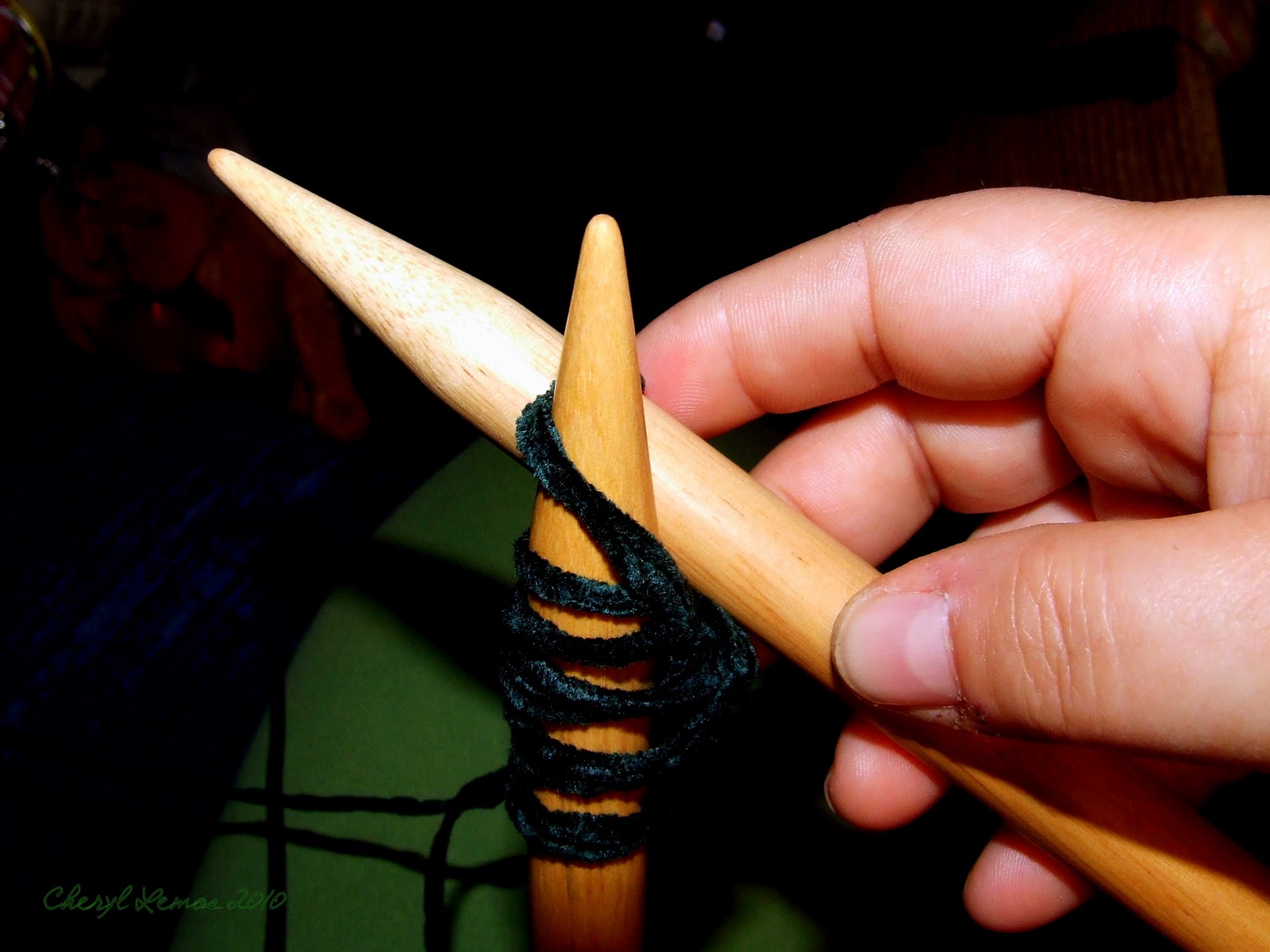
For this project I used a lovely deep green Chenille yarn and size #19 needles. Exact gauge is not essential to this project.

For the scarf:
With 2 strands of yarn held together, cast on 10 stitches. Work in Garter stitch(1) until piece measures 66"  from beginning. Bind off. Weave in ends.


For the Fringe:
Cut ten 40 in. long strands of yarn for fringe. Using 1 strand per fringe, fold strand in half to form a loop. Insert crochet hook into bottom edge of Scarf and draw loop through. Draw ends of fringe through this loop and tighten. Attach fringe evenly across ends of Scarf.


(1) The Garter stitch is simple knit, knit, knit . . . row after row.  You may ask . . . isn’t knitting what knitting is about?  Yes, but, no.  Knitting is the art of creating a fabric by making interlocking loops of yarn. There are two basic ways to create these loops . . . KNIT and PURL:
  1. The action of inserting your needles through the bottom of a loop and pulling a new loop down and through the first loop is called 'knitting'.

  1. The action of inserting your needles from the top of a loop and pulling a new loop up and through the first stitch is called 'purling'.


Thursday, October 28, 2010

Knit your hearts with an unslipping knot


Chants for Learning to Knit

In through the front door, 
Once around the back. 
Peek through the window
And off jumps Jack! (knit stitch)

Up through the hole, 
Around the tree, 


See you right back! (casting-on)


Soft & Cozy Neck Warmer

This is a quick and easy project made up of knitting together three strands of a lovely purple bulky yarn with great big bulky needles.

It only took me a couple of hours to knit up this super soft and cozy neck warmer. 

Here’s how I did it. . .

You will need:
  • 3 balls of bulky yarn . . . I used Sensation Holiday Shimmer in a rich purple.
  • 12″ US 19 needle
  • 1 large button

The total length of the neck warmer is about 33”.  The gauge is not critical for this project.

PATTERN
Holding a strand from each ball, CO 9 stitches.
Row 1 – *P1, k1; repeat from * to end.
Repeat Row 1 until approximately 28 inches.
Add a buttonhole in the middle of the row.  Make the button hole to fit the size of the button you’ve chosen.  My button hole was two stitches.  If you are using a smaller button you may not even need to place a button hole.
                       
Knit to the point where the buttonhole will be placed.
Slip the first stitch on the left needle as if knit.
Move the yarn to the front of the work and leave it there. Slip the next stitch from the left needle to the right needle as if to knit. Pass the first slipped stitch over the second slipped stitch and off the needle. Repeat until you have bound off the number of required stitches for the buttonhole.
Slip the last stitch from the right needle back to the left needle. Turn. Bring the yarn to the front of the work. At the edge where the buttonhole was begun, cast on the number of stitches you bound off plus one additional stitch. The twisted purlwise cast on is a good choice.
Turn. Slip the first stitch from the left needle to the right needle as if to knit. Pass the extra cast on stitch over the next stitch; then slip this stitch back to the left needle.

Continue knitting pattern until piece is approximately 33”.
Bind off loosely in pattern and weave in ends.
Attach button to center purl stitch approximately 1 inch from cast on edge.

Cozy and warm!  A wonderful pattern for a last minute gift!


This lovely cowl is for sale at my Etsy store.

Saturday, October 23, 2010

Weekend Whimsy . . . A small price to pay

Oooooh!  $350 for brillo!  Sweet!


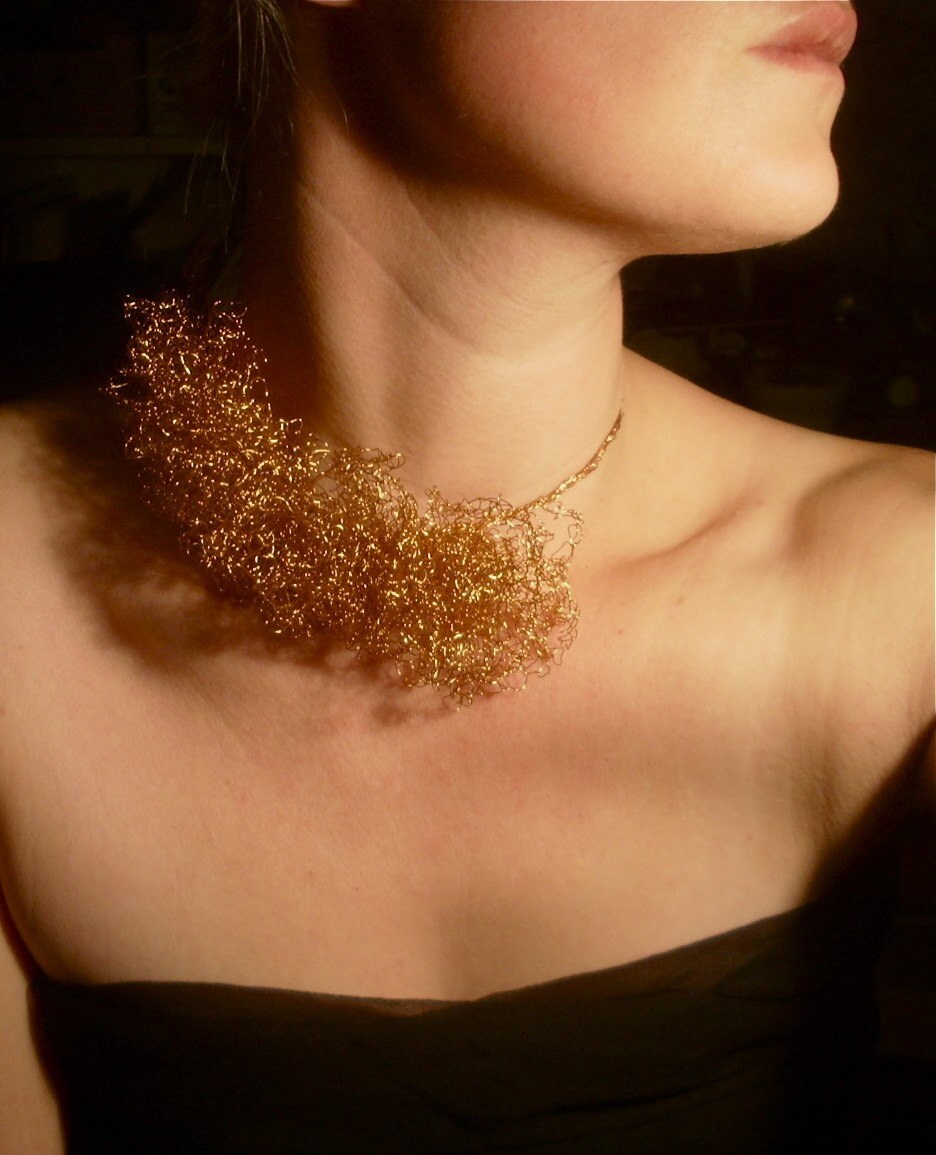
The Golden Fleece - Spun and Knit - Necklace

The Golden Fleece - Spun and Knit - Necklace
zoom
The Golden Fleece - Spun and Knit - NecklaceThe Golden Fleece - Spun and Knit - NecklaceThe Golden Fleece - Spun and Knit - NecklaceThe Golden Fleece - Spun and Knit - NecklaceThe Golden Fleece - Spun and Knit - Necklace

Description

A bold statement necklace that is intricately gorgeous and easy to wear. Wear it with anything with an open neckline.

Over 10 metres (11 yards) of hand-knit wire were used to created this fabulous, one-of-a-kind necklace.

Looped lengths of knitted wire form the intricate golden mass that increases in volume as it nears the centre. The loops have been sewn (with wire) onto a chain of knitted and woven wire.

End to end, this neckpiece measures 38cm (15"). The hand-formed and hammered clasp and rings can add up to 5cm (2") of extra length. If desired, extra links can be added.
Added on Aug 13, 2010


Thursday, September 23, 2010

'X' Marks the Spot - Part 1


Cross-stitch is a skill I learned as a child.  It’s a pleasurable distraction that is useful as well as beautiful.  It is a form of embroidery in which X-shaped stitches are used to form a picture.
 When I was learning I did a form of cross-stitch called stamped cross stitch.  This is where the pattern is printed on the fabric and the stitcher marks the ‘X’ over the outline.  It is easy and doesn’t require a lot of thought.

Now that I’m all grown up and enjoy more of a challenge, I prefer counted cross-stitch.  With this form, the stitches are counted across a blank canvass using a pattern and color chart to make the desired image. 

I generally buy a kit with the fabric and floss and pattern all together in one package.  Although, I have made my own patterns with success. 

Cross-stitch is usually carried out on an even weave fabric called aida cloth; which allows for stitches are uniform size and appearance. Cotton floss is the most common embroidery thread made up of six strands that are only loosely twisted together and easily separable. Sometimes other specialty threads are used for accents and embellishments.

To start, find the center of the graph. Most patterns show this with arrows or a bold line. Next, find the center of your fabric. An easy way to do this is to fold the fabric in half vertically and "pinch" with your finger to make a small crease. Open the fabric, fold in half horizontally and make another "pinch". Open the fabric up. The two creases will mark the center of the fabric. It is easiest to start at the center of the pattern.

To begin stitching, bring the threaded needle up from the back of the fabric leaving about a 1" tail of thread behind the fabric.  There is no need to knot it.  Stitch the next 5 or 6 stitches over the tail. Clip off extra thread. To end off, weave your needle back through the last 5 or 6 stitches and clip the thread short so as not to leave a loose tail.

There are two methods methods for stitching.  I’ve used them both and have no real preference for either.  The first method is to work a row of half stitches (////), then work back (\\\\) to complete the X's. Use this method for most stitching. The second method is to complete each X as you go. Use this method for vertical rows of stitches.
It is important that all the X's are crossed in the same direction. That is, the top thread of the X should always slant in the same direction (either \ or /). It does not matter which way they slant, but if they are mixed the finished piece will look uneven.

Do not pull the thread tight.  Relax and enjoy making the pattern.  Your stitches should lay flat on your fabric and not distort the holes or the fabric.
Sometimes a color will have only a few stitches and then "jump" to another area. Most of the time you should end off and start again, other times you can carry the thread along the back. Just jumping from area to area is easier than starting and stopping, but sometimes the thread will show through.

When your stitching is complete, wash in cool water using a mild liquid detergent. Rinse well. Do not wring, but roll in a clean towel to absorb most of the water. While still damp, place face down on a terry towel. Place another cloth on top of the needlework and press lightly with a warm iron. Let dry. Then frame or finish as desired. 

Saturday, August 21, 2010

Who you callin' a cootie queen, you LINT LICKER!?

Lint . . . not the stuff you pluck from your belly button . . . the fluff you remove from the trap in your dryer . . . believe it or not that fuzzy material is recyclable.  Waste not want not and all that happy scrappy hippy skippy doo-da.
First of all, lint is extremely flammable.   That’s just one of the reasons you should be cleaning out the lint trap every time you use the dryer.  Lint makes excellent fire starter.  You can use lint as is, just be sure to store it in a container to keep it from catching fire when you don’t want it to.  Another way to use lint as a fire starter is to pack it into paper egg carton cups and drizzle with melted paraffin or candle wax – it makes storing them easier and you get to recycle egg cartons, too!
 You can spin lint into thread, much like wool, and you can knit or crochet it into a cozy garment or blanket!  It will have more strength if you spin it with wool.
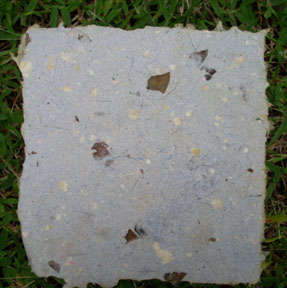
Dryer lint can be used to make homemade paper. Just put your dryer lint into a blender along with some old shredded paper. Soak the paper and lint with water and wait fifteen minutes. Next blend the mixture on medium speed. Pour your paper and lint mixture onto a screen and shape your paper. Press the excess water out of the paper and allow it to dry. Now you can point to your piece of homemade paper and say, “Hey! That used to be my shirt!”

Lint can be used to stuff hand crafted toys or pillows.  You can also use it as fill for quilting.   Lint is clean and dry and smells good, too!

Lint makes excellent nesting material for pet hamsters, gerbils and the like.   Why spend money on something that you have a perpetual supply of?

Since lint is made up mostly of natural fibers, you can add it to your compost.

There you have it . . . do what you will.


Wednesday, August 18, 2010

It feels cozy when you have it on

This is a pattern for wine cozies that I've used with success.  It's a quick knit and makes a great gift for the wine lovers in your life.  They will keep white wine cool and red wine warm.  

You'll need a bulky 100% wool yarn.  You can use leftovers from other projects, mix and match colors . . . whatever . . . just have fun and you'll end up with a totally cool (or warm) cozy.

You'll be knitting with big, fat yarn and big, fat needles and your project will look WAY too  big and fat.   That's okay because after you felt it up it  and block it the cozy will fit a wine bottle perfectly.

Wine Cozy

Needles: Size 13 dp, or size to give you proper guage
Gauge: 2.5 sts/in (approximately - not critical!)

With your main color, cast on 8 sts and join for working in the round, being careful not to twist.

First, knit the base:
k 1 round.
*k1, m1, repeat from * to end. 16 sts.
k 1 round.
*k2, m1, repeat from * to end. 24 sts.
k 1 round.
*k3, m1, repeat from * to end. 32 sts.
k 1 round.
*k4, m1, repeat from * to end. 40 sts.
k 1 round.

Now turn the corner:
purl 2 rounds.

Now head up the sides:
knit, knit, knit, changing colors when the mood strikes you. 
Continue until the sides measure about 10.5" from the purl ridge to the top, and bind off.

Weave in ends, and felt! 

Felting (fulling)
Put the cozy in the washer along with a pair of jeans or canvas tennis shoes. Use a small amount of mild detergent (such as: Woolite) and a low water level with a hot temperature. Wash for five minutes. Stop the cycle and check to see if is felted as tightly as desired; 
opening up the inside to keep it from fusing together and pulling it into the approximate shape you need.  Remember, the longer you wash it, the smaller and more felted it will become. If it is not quite felted enough, continue washing and carefully check every few minutes. As you get closer, have a bottle of wine on hand to test the fit.  When felted, remove and rinse in cold water. Blot with towel. 

Once it's wine bottle size, pull it onto a bottle and yank it into shape (a little snug is good - it'll be perfect when done blocking). Leave it until the sides are dry, then remove the bottle and turn the cozy over to let the bottom finish drying.


Pattern and photos by: Lydia McNeil

Sunday, August 15, 2010

Knitting Keeps Me From Unraveling

 William Shakespeare


This pattern is a quick fun way to get rid of scraps of sock yarn.  And, they're awfully cute, too.


Mini Sweaters


Materials
Fingerling weight yarn & double-pointed needles size 1 or 2 – a specific gauge is not needed since these are a decorative ornament.

Basic Pattern Directions

Cast on 30 stitches. Divide stitches between three needles with 10 stitches on each needle.
Round 1 & 2: * K1, P1, repeat to end of round.
Round 3: K2, Place Marker (PM), K10 (front), PM, K5 (sleeve), PM, K10 (back), PM, K3.

You should have 5 stitches between the markers for the sleeves, and 10 stitches between the markers for the front and for the back.

Raglan Increases
Round 1: *K to 1 stitches before marker, K1F&B, Slip markers, K1F& B, repeat 4 times to finish round.
Round 2: K all stitches.
Repeat the raglan increases 5 times (including the first time) until there are 15 stitches between the sleeve markers, and 20 stitches for the front.

Body
On the next round, K to the first marker, remove marker and slip sleeve stitches on to waste yarn or a spare needle. Remove the second marker, then knit the back stitches. Remove the 3rd marker and place sleeve stitches on waste yarn, then keep 4th marker in place to mark the beginning of your round from here on. Redistribute the body stitches on the three needles.

If desired, begin two-strand pattern (see below). Knit the body stitches until the body measures 1 inch from the underarm.
Knit 2 rounds of *K1, P1, ribbing.
Bind off all body stitches.

Sleeve
Pick up sleeve stitches from waste yarn on to three needles, and pick up 2 stitches from under arm area. (17 stitches total) The round begins at the under arm point.
Round 1: Knit all stitches.
Round 2: K2tog, K remaining stitches.
Repeat these two rounds until only 12 stitches remain and arm measures roughly 1" from underarm.
Knit 2 rounds of *K1, P1, ribbing.
Bind off all body stitches.
Repeat for second sleeve.
Finishing
Weave in all ends except the initial cast-on tail. Bring the tail across the neck of the
sweater and tie on the other side, leaving a loop which can be put over the branch of
the tree to hang. Weave in any remaining end.