Tuesday, January 25, 2011

The noble spear of the Sun King


“(Louis XIV) was graceful, dignified and awe-inspiring, if humourless.”


Louis XIV became king of France in 1643 at the age of 5 on the death of his father.  He ruled with an iron fist for 72 years.
           
Louis XIV grew into a handsome young man in good health.  He was seen as a strong king . . .  he was an excellent huntsman as well as an unabashed womanizer.   However, he took his position as king very seriously.  He wanted the best for France and demanded nothing less than absolute royal rule.

He was famous for the building of the Palace at Versailles and his association with the noble prisoner known only as “The Man in the Iron Mask”.  The identity of this prisoner has been a topic of debate amongst historians for centuries.  The prisoner was given special privileges the utmost respect - he was given fine linens, special meals and saw visitors by appointment.  No one ever saw his face, which was hidden by a mask of black velvet cloth.  A popular belief is that the masked prisoner was actually the twin brother of King Louis XIV, imprisoned because he was seen as a threat to the throne.   It was also suggested that he had been an English Lord or an Italian Count. 


King Louis was also well-known for his love of asparagus.  In the 16th Century, asparagus was very expensive and difficult to obtain.  Louis so enjoyed this delicacy that he ordered special greenhouses built for a year-round supply.


Asparagus is low in calories, high in fiber and rich in iron.


Let me tie this all together for you . . .

King Louis ruled with an iron fist, had a prisoner in an iron mask and enjoyed iron rich vegetables . . .

That is all.


_____________________


I love asparagus.  Now.  But as a kid all I remember of asparagus is the floppy, soggy stuff my mom used to dump from a can and cook to mush.   All I can say about that is . . . yuck.

Fresh asparagus is a whole other thing entirely . . . fresh, crisp and uniquely flavorful.  It’s so easy to prepare and readily available that I can’t imagine why someone would opt for the mass produced smooshy canned variety.  Asparagus is pricier then other vegetables but when it’s in season . . . February to June . . . it is affordable.

Asparagus is a versatile ingredient in the kitchen . . . it can be boiled, broiled, baked, steam and added to other recipes.  Personally, I like it best roasted with a drizzle of olive oil, a sprinkle of coarse salt, a grind of fresh pepper and a squeeze of lemon juice.

Simply place the spears in a large roasting or baking dish and cook in a pre-heated oven (400F) for about 25 minutes.
  
Before you cook your asparagus, you need to first rinse it off to remove any grit (it grows in sandy soil) and then you need to remove the woody stems which are rather tough and fibrous. Simply bend each spear until it breaks at its natural breaking point. Using the breaking method will make sure that you end up with nice tender spears of asparagus without any waste.
  

To revive limp asparagus, try placing them in a tall pot with ice water in the refrigerator for thirty minutes.


 __________________


Bacon Wrapped Asparagus Bundles

•           1 1/2 pounds asparagus spears
•           Extra-virgin olive oil, for drizzling
•           6 slices thick center cut bacon
•           Fresh ground pepper
•           Hot Paprika


Preheat oven to 400 degrees F.

Prepare the asparagus by rinsing them thoroughly to remove any sand and grit.  Pat dry with a paper towel.  Break the woody ends off by holding it gently on both ends & bending, the asparagus will break at the right point. You'll find that you lose more of the stalk with thicker asparagus than with the young thin spears


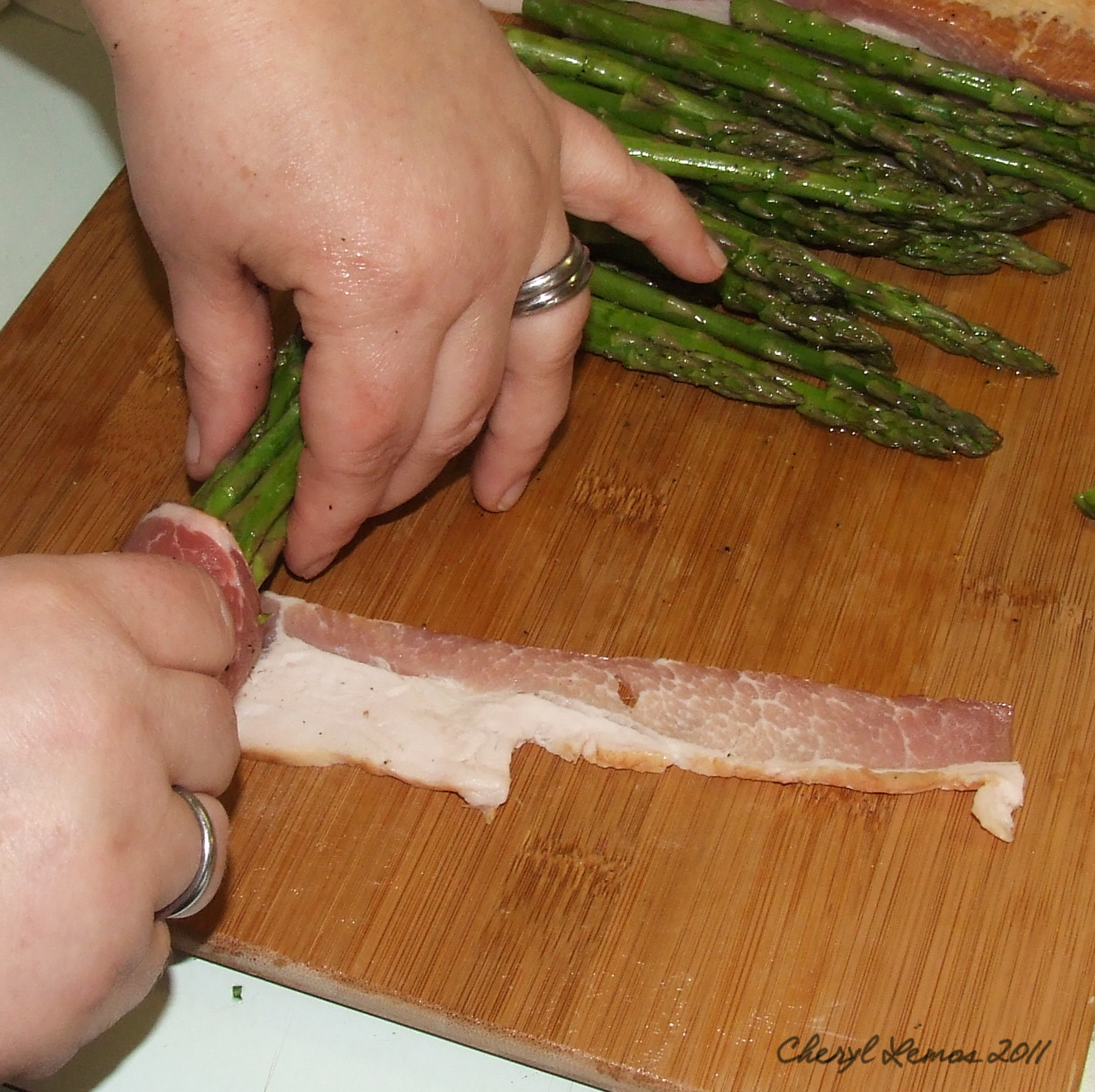
Lightly coat asparagus spears in extra-virgin olive oil.  Take a quick count of the spear tips. Divide the total number by six. Gather that number of spears and use a slice of bacon to wrap the bundle and secure the spears together.


Sprinkle the wrapped spears with a few grinds of black pepper and paprika.


Place the bundles on slotted broiler pan or on wire rack set into a baking sheet.  Bake 12 minutes.


Monday, January 24, 2011

Bonus Video . . . shootin' in the snow

Hokey pokey, penny a lump


Ice cream vendors, most of them Italian immigrants, would travel up and down the street shouting ecco un poco! or O che poco!; meaning "here is a little".  The phrase meant that the ice cream was cheap not that you would only get a little.   These purveyors of frozen delights got the nick name Hokey Pokey Men . . .  a corruption of the Italian ecco un poco


Even though Italy claims to be the birthplace of ice cream, it became so synonomous with American culture that Mussolini banned the sale of it in his country.  The dictator was said to call his country-men "mediocre race of good-for-nothings only capable of singing and eating ice cream."  It’s no wonder the Italians were not motivated to fight for the man.


____________________


Ice cream was utilized during World War II as a special treat to boost the morale of American service men.  In fact, the Navy commissioned a concrete barge that its sole purpose was to produce ice cream.  This million dollar “floating ice cream parlor" was capable of producing ten gallons of ice cream every seven seconds. That’s nearly 1,500 gallons every hour!


After the war was over two veterans, one of which actually worked on the Navy’s ice cream barge, opened a franchise of ice cream stores.   You may recognize the name of this little chain of shops . . . Baskin Robbins!

How cool is that??


________________________

Play and Freeze Mega Ice Cream Maker,Quart,Red

In a previous post I demonstrated how to make sherbet (or ice cream) using nothing more than two zip top freezer bags.  For this recipe I am demonstrating using an ice cream ball . . . formally known as the Play & Freeze Ice Cream Maker.

My husband and I love to camp.  We tent camp but we don’t rough it, by any means.  We got our ice cream ball to use on camping trips.  I remember a particular hot and steamy campout where the ice cream on a sweltering hot day was a life saver.  It was pretty darn awesome to be eating camp pie ala  mode!


With the unique Play & Freeze™ Ice Cream Maker, you can make ice cream anywhere! You don’t need electricity, just add ice and rock salt in one end and ice cream mix in the other end–then have a ball as you shake it, pass it or roll it! The ice cream mix can be as simple as cream, sugar and vanilla. Try flavors from our recipe list included or make up your own. Made of durable materials, it’s lightweight, portable and easy to clean. It’s ideal for Camping, Boating, Picnics, Parties, Travel...anywhere!

Mint Dark Chocolate Chunk Ice Cream

4 Cups ½ And ½ Milk
1 Cup Sugar
1/2 Teaspoon Salt
1 Teaspoon Vanilla Extract
1 Teaspoon Peppermint Extract
1 Cup Chopped Dark Chocolate Bar

In a large bowl, stir together the milk, cream, sugar, salt, vanilla extract and peppermint extract until the sugar has dissolved.

Fill the ice end with as much ice as possible, then add 1/2 cup of rock salt.  (MEGA: Add 3/4 cup of rock salt). The lid should be hand tightened - do not use the wrench!

Pour your ice cream mixture into the end with the metal cylinder, leaving about an inch for expansion at the top. Hand tighten the lid.

Have a ball! Shake, roll and pass it around as you mix and freeze the ingredients. Its not necessary to shake the ball...just motion will do it!       

After about 10 minutes (15 for the MEGA ball) open the ice cream end using the included plastic wrench.  Scrape the sides of the cylinder to mix up the ice cream using a plastic or wooden spoon (don’t use a metal spoon as it will scratch the cylinder). Then check the ice end. Pour out the excess water and add more ice and up to 1/3 cup more rock salt to enhance the freezing ability. Close the lids securely and continue having a ball for approximately 5–10 more minutes. (15 for MEGA)

You now have about a pint (or quart for the MEGA ball) of delicious soft-serve ice cream. The consistency will vary based on the ice, your mix, the outside temperature, shaking frequency, etc. Once the ice cream is to the consistency of your liking, gently scoop it out and Enjoy!


Or . . . pour the mixture into an ice cream maker, and freeze according to the manufacturer's instructions.

After about 10 minutes into the freezing, add the chocolate chips. After the ice cream has thickened, about 30 minutes later, spoon into a container, and freeze for 2 hours.

Saturday, January 22, 2011

Come on . . . do the twist!


The French Twist is a classic and elegant hairstyle that first gained popularity during the Victorian Era when sleek, shiny and healthy hair were the vogue and fashions were overall more modest and demure. 

Do you ever wind your hair up in shove a pencil in it to keep in place to get your hair out of your face?  If you can do this then you can do a French Twist. This is nothing more than a casual version of the classic style.   
If you have shoulder length hair or longer, the French twist is a simple hair-do that you can easily do yourself in minutes.  You can wear it casually or add some curly wisps for a more refined look.


Since the style is meant to be sleek and smooth, comb or brush your hair well. 

Pull your hair up into a loose ponytail with the hair framing your face in a way that you find flattering.

Hold the ponytail with your hands and start twisting. The number of turns determines how tight the twist will be.  You'll notice the bottom of the ponytail tightening against your head.

Hold your ponytail upright pointing up towards the ceiling.  Tuck the end of your ponytail into the space between your head and the beginning part of your ponytail.
As you tuck the ends of the ponytail in, you'll slowly roll your wadded-up ponytail in the direction of your twist.   I grip the seam between my ponytail and my head between my thumb and my four other fingers, and use my thumb to push the hair beneath in while rolling the hair on top in. You will feel the twist tightening against your scalp. Keep pushing and rolling your hair until it feels secure.

Use straight or bobby pins (depending on the thickness of your hair) to hold the hair in place and to demarcate the line that is created by your French twist.  Alternatively, you can use a hair comb or clip to hold your twist in place.


I may take some practice to get a the twist down just right but in the long run it will save you time.  This style doesn’t require a blowdryer, curling iron or rollers . . . for me it’s a run-out-of-the-house-because-I’m-running-late hair-do.  And you thought I was being stylish . . . ha!  Fooled you!


Friday, January 21, 2011

Firewater Friday . . . Cher’s Berry Cosmo

Everyone is familiar with Cosmopolitan Magazine . . . but what you may not know is that when it was first published in 1886 it was meant as a family magazine.  Originally, the content included articles about fashion, home décor, recipes, child rearing, etc.  Also included in the early versions of Cosmo was a section for the children of the family.   It was meant to have something for everyone. Within a year Cosmopolitan had a circulation of 25,000.

Two years later, the magazine found itself with a new editor and a new format.   The updated style of the magazine incorporated serial fiction, book reviews and colour illustrations. Contributers included Theodore Dreiser, Rudyard Kipling, Jack London and Edith Wharton.   Even H. G. Wells had two of his books, The War of the Worlds (1897) and First Man in the Moon (1900), serialized in the magazine. Cosmopolitan soon became of America's leading magazines.

 
Hearst publishing purchased the magazine 1905.  With the hiring of renowned journalists Charles Edward Russell, David Graham Phillips and Alfred Henry Lewis, the monthly transformed into a source for topical political analysis and social commentary.  By the 1930s the magazine had a circulation of 1,700,000.


The next few decades the magazine changed from strictly articles to short novels and stories.  During the more serious times brought on by two world wars and the Great Depression, the demand for fiction dropped.  Although the magazine’s readership dropped it was still profitable.

In the 1960’s the magazine got a whole new makeover.  The new Cosmo tackled previously unmentioned topics like birth control, sexual malfunction and social diseases.  The magazine was as much about feminism as being feminine.

Cosmo has matured into a sexy, sophisticated guide for women where it seems no topic is off limits.


Cher’s Berry Cosmo

~ 1 Oz Blueberry Vodka ~
~ ½ Oz Triple Sec ~
~ ½ Oz Rose's Lime Juice ~
~ ½ Oz Cranberry Juice ~

Shake vodka, triple sec, lime and cranberry juice vigorously in a shaker with ice. Strain into a martini glass, garnish with a maraschino cherry, and serve.


Thursday, January 20, 2011

Enigma del Carbone

A king once lost his way, and happened to come to the house of a poor charcoal maker.  The man, though obviously poor, welcomed the king graciously and offered him what little food there was in the house.

Seeing the charcoal maker's humble condition, the king was filled with curiosity and said to the man, "Tell me, my good man, how much money do you get from making and selling charcoal?”

"Ten cents a day, Your Majesty,” the man answered.

"Ten cents a day! And you manage to survive?" asked the king in amazement.

"Oh yes, said the man cheerfully.”It is enough to live on.  And with that ten cents a day I also mange to pay a debt, save for my old age, and have something left to throw out the window."

"This I cannot believe," said the king.  "How is this possible?"

"Well,” said the man, "my aging mother lives with us, and caring for her pays the debt that I owe my parents.  And I care for my son whom I hope will care for me in my old age; thus, I save for the future.  And every so often I set aside another penny for my daughter's dowry, which is certainly like throwing money out the window."

The king chuckled.  "That is good.  Very good.  Now, you must do me a favor and promise not to tell that riddle again until you have seen my face 100 times."  To this the poor charcoal maker agreed.

The king's party soon came along.  The king reminded the man of his promise, and then he left.

Soon after, the king posed this same riddle to his court.  "How is it that a man who makes only ten cents a day can have enough to live, to pay a debt, to save for the future, and throw some out the window?  The first man to answer this within the next month will be freed from paying taxes for the rest of his life.

Everyone was baffled by this riddle, but after thought, one of the members of the court concluded, "The king asked this riddle right after he got lost and went to that poor man's hut.  He must have learned it there.” So he jumped on his horse and rode back to the place where the charcoal maker lived.

"You know, said the man, how a man can live on ten cents a day and still pay a debt, save for the future and throw some out the window.  "

"Yes," said the charcoal maker, “I know, but I may not tell you"

"I will pay you ten silver pieces,” said the man.

"No, I cannot tell you,” said the charcoal maker.


"Very well, I will giver you fifty silver pieces," said the man.

"No, I cannot tell you,” said the charcoal maker.

"What if I give you one hundred silver pieces?" said the man.

"Let me see the coins," said the charcoal maker.  After examining and counting them carefully, he said," Very well, I will tell you the answer," and he told the man the answer to the riddle.

 The man smiled, thanked the charcoal maker, and then road back to the court at once.  There he told the answer to the court, much to the astonishment of the king.

The king became furious. "Summon the charcoal maker at once," he cried.

The charcoal maker was brought into the court and made to stand before the king's throne.  "Did you tell the answer to the riddle?" asked the king.

"Yes. Your Majesty.”

"Why? You broke your word to me!" shouted the king. ”You will be beaten and thrown into prison for a year"


"I did not break my word to you, Your Majesty," answered the man humbly. "You said that I could tell the answer once I had seen your face one hundred times."

"But you have not seen my face again even once since the day I left your house"

"But, Your Majesty, replied the charcoal maker," I have.  “Your face is stamped on each of the silver coins I was given, and since there are one hundred of them, I have seen your face one hundred times.

At this the king was greatly impressed. He set the poor charcoal maker free, and gave him a gift of three bags of gold.


“One for your debt, one to invest, and one to throw out the window.”


_________________________________________


Spaghetti Carbonara is a wonderful dish that is extremely simple in composition and extremely flavorful.

There are many conflicting opinions of how this wonderful dish originated.   One is that Italian charcoal makers - I carbonari – would travel with the ingredients on their expeditions.  The elements of Spaghetti Carbonara - dry pasta, pancetta and cheese – would be easy to pack and travel with.  They could easily collect eggs from various sources along the way.  It seems logical that the dish is named after these "carbonari" and it goes well with the story.

Nobody really knows how the dish originated, but it’s a good theory.

 Classic Spaghetti Carbonara

•           1/2 Pound Bacon, Salt Pork or Pancetta - Chopped
•           1 Tablespoon Chopped Garlic
•           Freshly Ground Black Pepper
•           1 Pound Fresh Spaghetti, Cooked Al Dente
•           4 Large Eggs, Beaten
•           Salt
•           1 Cup Freshly Grated Parmigiano-Reggiano
•           1 Tablespoon Finely Chopped Fresh Parsley Leaves


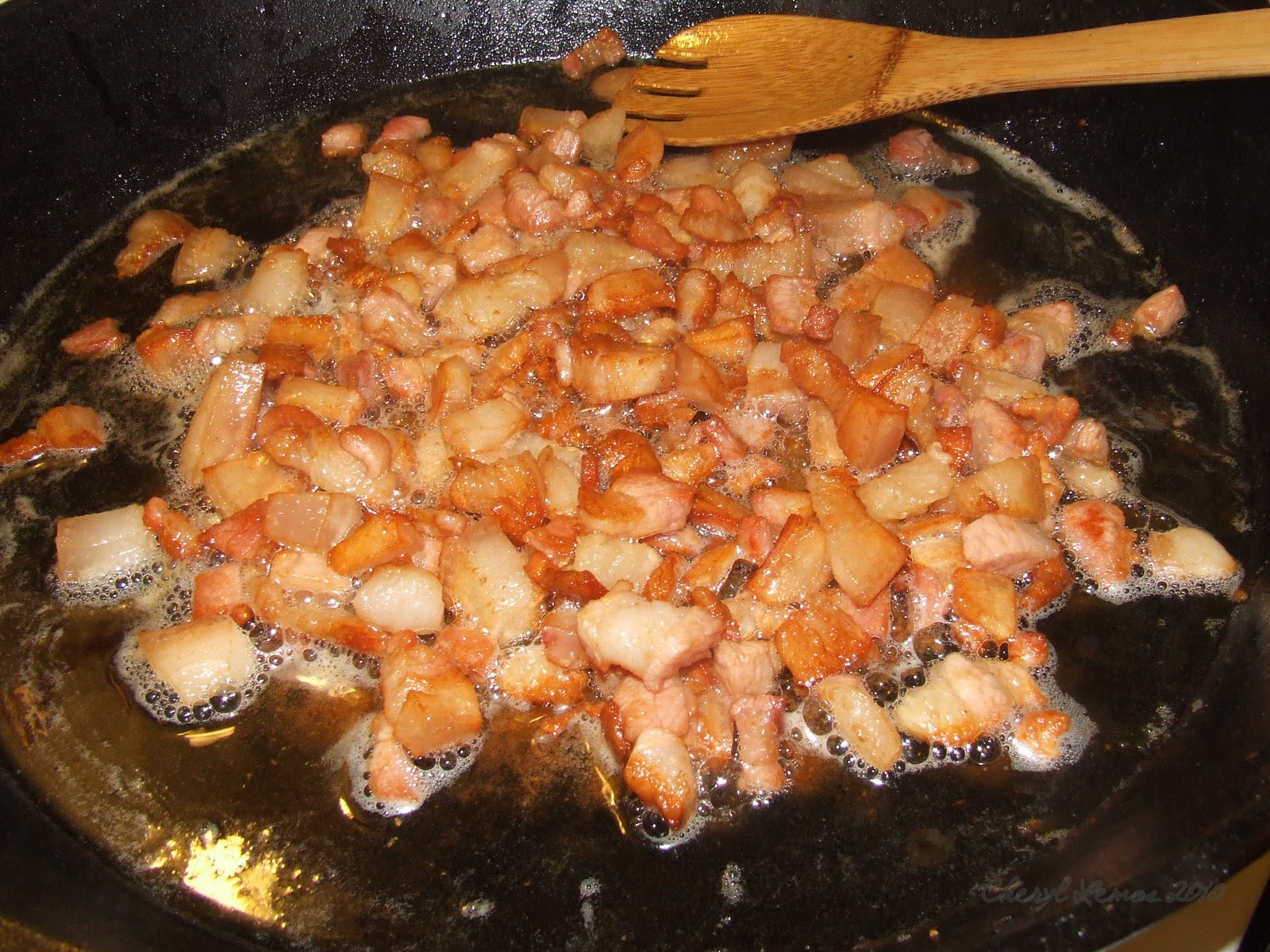
In a large sauté pan, over medium heat, cook the bacon until crispy, about 6 minutes. Remove the bacon and drain on paper towels.
 Pour off all of the oil except for 3 tablespoons. Add the garlic. Season with black pepper. Sauté for 30 seconds. Add the crispy bacon and the pasta. Sauté for 1 minute. Season the eggs with salt. Remove the pan from the heat and add the eggs, whisking quickly until the eggs thicken, but do not scramble. 
Add the cheese and re-season with salt and pepper. Mound into serving bowls and garnish with parsley.

Seriously . . . NOM-dilly-icious!


All of the eggs I used in this recipe were courtesy of my good friends Stephanie and Phil.  
If you live in or near Connecticut and want farm fresh eggs, contact Stephanie for pricing and availability.